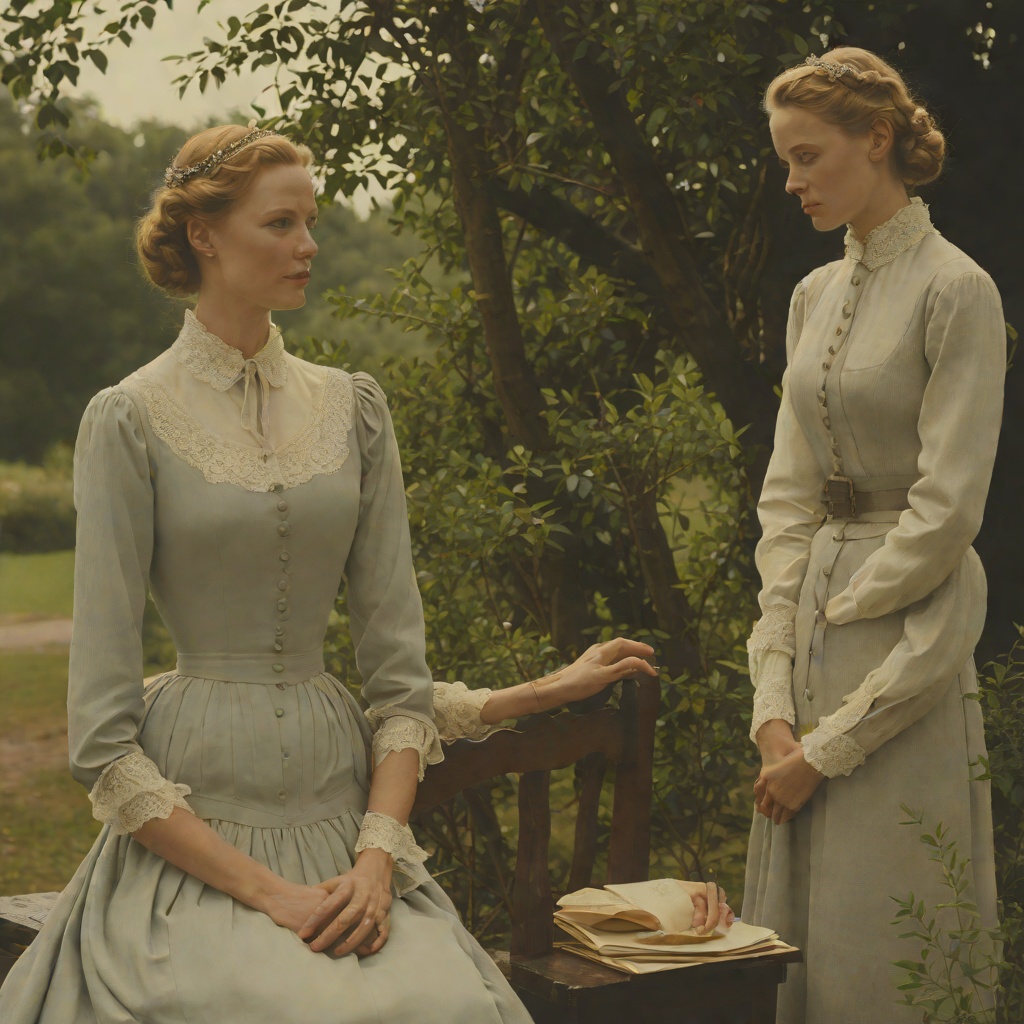
Isaiah the Scribe
The Captain and Ann BarbaraIsaiah the Scribe stands at the threshold of Mary Antin's intellectual life, the first teacher who was not a rebbe but a lehrer, a secular instructor. Where the heder had taught only Hebrew, the province of every girl in Polotzk, Isaiah could teach Yiddish and Russian and, some said, even German, along with letter-writing and arithmetic done on paper without a counting-frame — accomplishments extremely rare among girls in the town. The distinction was everything to his new pupils, who crossed his threshold with a pride Mary says she has no words to describe, knowing that nothing was too high for the grandchildren of Raphael the Russian, who had 'good heads,' as everybody knew.
The Schoolroom on the Edge of the Swamp
Mary's first school was a hovel on the edge of a swamp, gray within and without, with a door so low that Isaiah had to stoop in passing and little murky windows. The walls were bare, but the low ceiling was decorated with bundles of goose quills stuck in under the rafters, and a rough table stood in the middle of the room with a long bench on either side. In Mary's eyes on that first morning it shone with a wonderful light, a strange glory that penetrated every corner and made the stained logs fair as tinted marble, and the windows were not too small to afford her a view of a large new world. The inkwells were simply hollows scooped out in the thick table top, and Isaiah made his pupils serviceable pens by tying pen points securely to little twigs, though some used quills. He ruled their paper into little squares like a surveyor's notebook, and the girls copied one letter in each square all the way down the page, while the teacher, with so few pupils, could see everybody's page by just leaning over and rap with his ruler on clumsy knuckles. The scene was completed by the smell of his dinner cooking in some little hole adjoining the schoolroom and the sound of his wife — Mary cannot remember whether her name was Leah, Rachel, or Deborah — keeping order among his little ones, so that most of the time one could hear the scratching of the laborious pens accompanied by the croaking of the frogs in the swamp.
The Lessons and Their Abrupt End
Isaiah taught Mary and Fetchke for perhaps two terms in all, during which they learned Yiddish and Russian and a little arithmetic. But little good they had from their ability to read, for there were no books in their house except prayer-books and other religious writings, mostly in Hebrew, and their skill in writing had as little use, since letter-writing was not an everyday exercise and idle writing was not thought of. The lessons ended because the family fortunes began to decline and luxuries such as schooling had to be cut off, long before the sisters had exhausted their teacher's learning. Their good teacher, however, who had taken pride in their progress, would not let them lose all they had learned. Books he could not lend them, because he had none himself, but he wrote out for each a beautiful 'copy' that they could repeat over and over to keep their hands in.
The Pink and Blue Copy Letters
Mary's copy was in the form of a letter written on lovely pink paper — her sister's was blue — with the lines taking the shape of semicircles across the page without any guide lines showing. The script was perfect, in the best manner of Isaiah the Scribe, and the sentiments expressed were entirely noble. Mary was supposed to be a high-school pupil away on vacation, writing to her 'Respected Parents' to assure them of her welfare and to tell them how, in the midst of her pleasures, she still longed for her friends and looked forward with eagerness to the renewal of her studies. All this was in phrases half Yiddish, half German, and altogether foreign to the ears of Polotzk; Mary never heard such talk in the market when she went to buy a kopeck's worth of sunflower seeds. She wrote the graceful sentences out just about countless times, and yet she wonders that she has forgotten them.
A Teacher's Place in the Larger Story
Isaiah the Scribe belongs to the chain of teachers who carried Mary forward, from Reb' Lebe's heder to the Chelsea public school where Miss Nixon took her in hand. His schoolroom, like the heder before it, was a place of confinement in the Pale, yet Mary's memory transforms it into a place of glory, just as the cramped Union Place tenement would later appear to her as imposing brick buildings under an American sky. The copy letters he wrote out were a bridge between worlds, a secular exercise in a language half Yiddish and half German that anticipated the English she would later gather word by word, blossom by blossom, in America. His pride in his pupils' progress and his refusal to let their learning die with the end of the lessons mark him as one of the few figures in Polotzk who saw past the narrow educational standards of the town, where a girl was 'finished' when she could read her prayers in Hebrew and sign her name in Russian. Though his own learning was limited — he was, after all, only a girls' teacher in a town where nobody would pay much for teaching girls — he gave Mary her first taste of a broader path, one that her father's plans had marked out but that the monster poverty trampled down just as she and her sister were fairly started on it.